Good article. I am an NRI and I understand that STCG on debt mutual funds is at applicable tax rates and also STCG on debt MFs is added to overall income for taxation purposes. Does that mean I can recover the 30% TDS via filing tax return ( if I fall in the lower tax bracket overall) and is that true for both NRE/ NRO Debt MF investments? Please help clarify. What is the treatment of LTCG for NRIs and are they added to overall income while filing return?
Yes, Anand. You may file ITR and claim a refund on the TDS deducted on STCG on debt funds. and yes it is true for both NRE and NRO accounts.
In the case of LTCG, the provisions are different for NRIs and you will not be able to claim the benefit of basic tax exemption limit and are supposed to pay tax on the gains booked.
Hi Mani,
Thank you for creating a nice informative page. Can you confirm if my understanding is correct, for the below taxation for NRIs.
Let us say I am an NRI. I have Rs 490,000 as STCG from debt funds in an year and no other income.
1. Can I use both Basic Exemption Limit and 80c deduction for this gain? (Since STCG in debt funds is not covered under section 111a).
2. For FY2018-2019, can I use the standard deduction of 40000?
3. Am I eligible for tax rebate till 300000?
In summary, I can show taxable income as (300000 = 490000-150000(80c)-40000(std deduction)) and hence will not pay any tax?
Thanks,
BR
Hi Roy
I am glad you like my article. Please find my replies to your query point by point
1. Yes for Basic exemption (only in case of STCG) and No for 80 C savings.
2. No. The standard deduction applies only in case of Salary Income.
3. If you are above 60 years of age…the YES.
This is as per my understanding of tax laws and I am not a tax expert. So please do clarify the same from a tax professional.
hi Manikaran – thanks for your reply and clarification. Truly appreciate you taking time to answer the questions I had.
Thanks, Anand. I am glad i was helpful.
Thank you for creating a nice informative page for NRI
I I invest in tax free fund like ELSS, I can save tax also if I use STP method to invest in SIP what will be the Tax procedure.
Sorry, Suneesh. Don’t get your query completely. Could you Please elaborate?
Hi, I don’t agree with the last point u made in this article ‘ In fact, not only in mutual funds, NRIs are subject to TDS in almost all the investments they make in India’. What about the fixed deposit? The NRI fds don’t attract TDS.
Yes, NRE FDs don’t attract any TDS
WHAT IS THE POSITION ON THE INVESTMENTS IN MUTUAL FUNDS BEFORE GOING ABROAD, ON INCOME I HAVE ALREADY PAID MY TAXES.THOSE INVESTMENTS ARE STILL CONTINUING.WHAT SHOULD I DO WITH THEM
THANKS.
If you want to continue your mutual fund investments in India, then you would have to convert your saving bank a/c to NRO account, so that whenever you redeem those investments, money should come in that account, and update your KYC. However, the decision to continue depends on your financial plan and goals you have in mind.
Wheth the AMC will give the capital gains of the fund redeemed equity,liquid Every thing
I assume that you are asking about capital gains Report. Yes the AMC would provide the same, but you have to ask for it.
i am an indian staying in Mumbai.My son whose in USA is working ther under OPT after his studies.He wants in invest some money in mf can he do that
Yes he can do so if he is aware of the taxation on mutual funds in USA. USA taxes global income. Also, there is point in investing in mutual funds in India only if he has plans to come back to India for good in future and use that money in India itself. Otherwise, he may go for offshore funds, which invest in India also.
I read in the article, LTCG is tax free, but i was charged 10.4% tds on long term hybrid fund on 24th October.
Why is it so? .i am an NRI
What is the threshold level , above which LTCG tds can be deducted for NRI customer
It seems you are being mistaken, we have mentioned the tax rate on equity oriented Mutual Funds as 10.4% for NRIs in our article and there is no threshold limit for the same for NRIs.
I am an NRI. I want to know about taxes i need to pay for my Mutual fund returns in India
what is the tax % applicable & how its deducted?
Please read the article below, wherein we have mentioned in detail the taxation of Mutual Funds for NRIs, still if you are left with any queries, feel free to mention it in comments. https://www.goodmoneying.com/mutual-funds-taxation-nris/
Since ltcg on equities is fully deducted at source at 10 percent for an nri then does an nri need to file an income tax return if this is his only income?
Additional Query:
I am an NRI. Suppose Rs 40000 has been deducted as TDS from me and my taxable income in india is below basic tax-exemption limit. Can I claim back this TDS ? under which rule ?
I have ltcg of 1.95 lacs which is calculated at 10%. For an NRI do I need to pay tds of 10% on this or will the total 1.95 lacs be deducted as tds
We assume you are talking about Equity mutual fund long term capital gain, and in this case for NRIs, TDS gets deducted at the company level only. and will be on the Gain portion, not on the full amount.


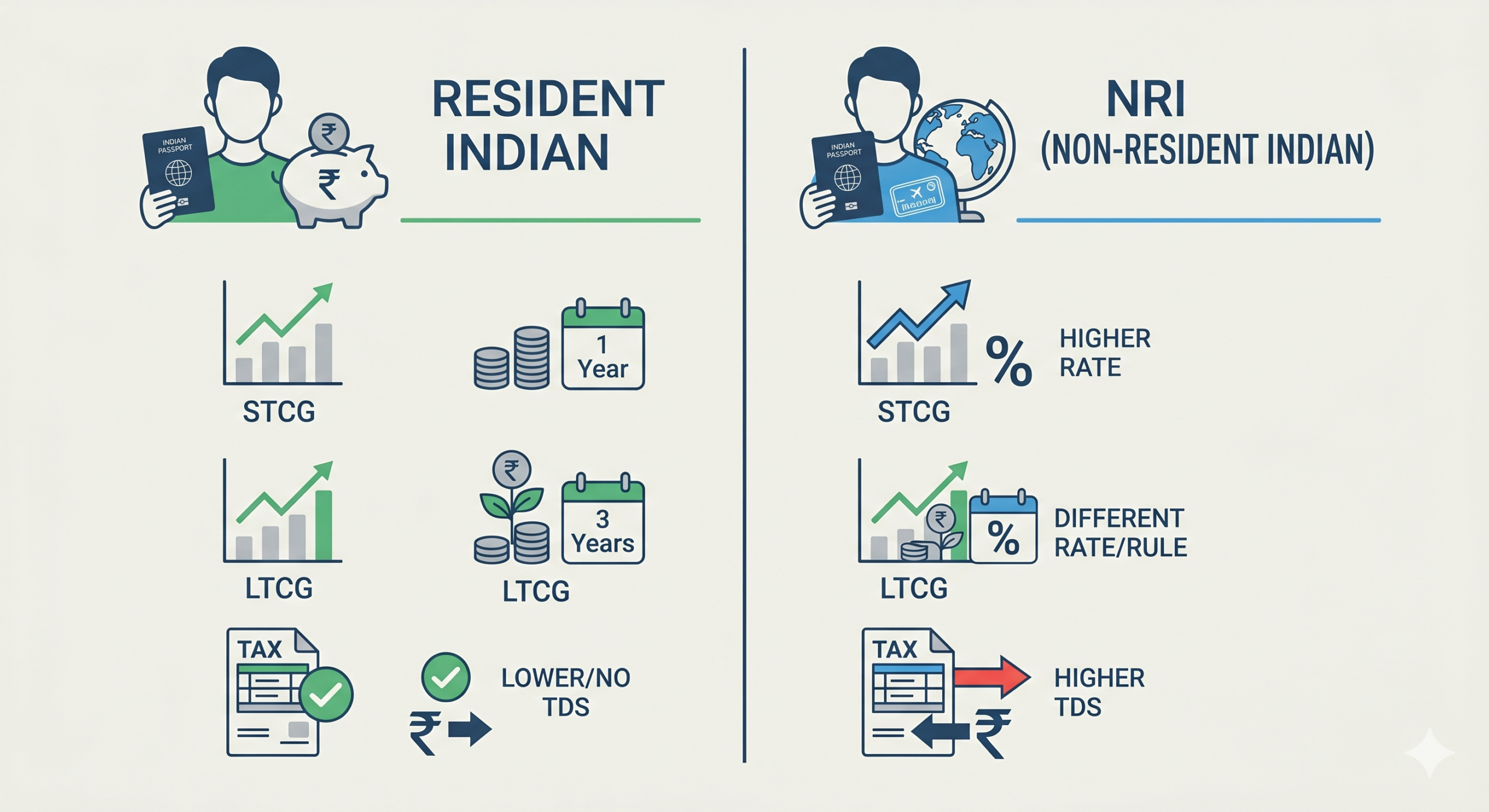




Good article. I am an NRI and I understand that STCG on debt mutual funds is at applicable tax rates and also STCG on debt MFs is added to overall income for taxation purposes. Does that mean I can recover the 30% TDS via filing tax return ( if I fall in the lower tax bracket overall) and is that true for both NRE/ NRO Debt MF investments? Please help clarify. What is the treatment of LTCG for NRIs and are they added to overall income while filing return?
Yes, Anand. You may file ITR and claim a refund on the TDS deducted on STCG on debt funds. and yes it is true for both NRE and NRO accounts.
In the case of LTCG, the provisions are different for NRIs and you will not be able to claim the benefit of basic tax exemption limit and are supposed to pay tax on the gains booked.
Hi Mani,
Thank you for creating a nice informative page. Can you confirm if my understanding is correct, for the below taxation for NRIs.
Let us say I am an NRI. I have Rs 490,000 as STCG from debt funds in an year and no other income.
1. Can I use both Basic Exemption Limit and 80c deduction for this gain? (Since STCG in debt funds is not covered under section 111a).
2. For FY2018-2019, can I use the standard deduction of 40000?
3. Am I eligible for tax rebate till 300000?
In summary, I can show taxable income as (300000 = 490000-150000(80c)-40000(std deduction)) and hence will not pay any tax?
Thanks,
BR
Hi Roy
I am glad you like my article. Please find my replies to your query point by point
1. Yes for Basic exemption (only in case of STCG) and No for 80 C savings.
2. No. The standard deduction applies only in case of Salary Income.
3. If you are above 60 years of age…the YES.
This is as per my understanding of tax laws and I am not a tax expert. So please do clarify the same from a tax professional.
hi Manikaran – thanks for your reply and clarification. Truly appreciate you taking time to answer the questions I had.
Thanks, Anand. I am glad i was helpful.
Thank you for creating a nice informative page for NRI
I I invest in tax free fund like ELSS, I can save tax also if I use STP method to invest in SIP what will be the Tax procedure.
Sorry, Suneesh. Don’t get your query completely. Could you Please elaborate?
Hi, I don’t agree with the last point u made in this article ‘ In fact, not only in mutual funds, NRIs are subject to TDS in almost all the investments they make in India’. What about the fixed deposit? The NRI fds don’t attract TDS.
Yes, NRE FDs don’t attract any TDS
WHAT IS THE POSITION ON THE INVESTMENTS IN MUTUAL FUNDS BEFORE GOING ABROAD, ON INCOME I HAVE ALREADY PAID MY TAXES.THOSE INVESTMENTS ARE STILL CONTINUING.WHAT SHOULD I DO WITH THEM
THANKS.
If you want to continue your mutual fund investments in India, then you would have to convert your saving bank a/c to NRO account, so that whenever you redeem those investments, money should come in that account, and update your KYC. However, the decision to continue depends on your financial plan and goals you have in mind.
Wheth the AMC will give the capital gains of the fund redeemed equity,liquid Every thing
I assume that you are asking about capital gains Report. Yes the AMC would provide the same, but you have to ask for it.
i am an indian staying in Mumbai.My son whose in USA is working ther under OPT after his studies.He wants in invest some money in mf can he do that
Yes he can do so if he is aware of the taxation on mutual funds in USA. USA taxes global income. Also, there is point in investing in mutual funds in India only if he has plans to come back to India for good in future and use that money in India itself. Otherwise, he may go for offshore funds, which invest in India also.
I read in the article, LTCG is tax free, but i was charged 10.4% tds on long term hybrid fund on 24th October.
Why is it so? .i am an NRI
What is the threshold level , above which LTCG tds can be deducted for NRI customer
It seems you are being mistaken, we have mentioned the tax rate on equity oriented Mutual Funds as 10.4% for NRIs in our article and there is no threshold limit for the same for NRIs.
I am an NRI. I want to know about taxes i need to pay for my Mutual fund returns in India
what is the tax % applicable & how its deducted?
Please read the article below, wherein we have mentioned in detail the taxation of Mutual Funds for NRIs, still if you are left with any queries, feel free to mention it in comments.
https://www.goodmoneying.com/mutual-funds-taxation-nris/
Since ltcg on equities is fully deducted at source at 10 percent for an nri then does an nri need to file an income tax return if this is his only income?
Additional Query:
I am an NRI. Suppose Rs 40000 has been deducted as TDS from me and my taxable income in india is below basic tax-exemption limit. Can I claim back this TDS ? under which rule ?
I have ltcg of 1.95 lacs which is calculated at 10%. For an NRI do I need to pay tds of 10% on this or will the total 1.95 lacs be deducted as tds
We assume you are talking about Equity mutual fund long term capital gain, and in this case for NRIs, TDS gets deducted at the company level only. and will be on the Gain portion, not on the full amount.